One of the leading global infrastructure operators
Infrastructure and data centers
Digital twin, energy simulation, and data center optimization
Energy consumption is one of the key variables in data center planning and operation. Room layout, rack types and count, cooling systems, weather conditions, and power procurement models can significantly impact electricity demand, associated costs, and carbon emissions.
For an international infrastructure development company, being able to anticipate this behavior prior to key decision-making allows for a much more precise comparison of alternatives and an accurate evaluation of their energy, economic, and environmental impact.
The project was thus created to provide a tool capable of transforming various data center configuration hypotheses into a detailed, long-term view of their energy behavior.
Challenge
The main challenge was to anticipate data center energy consumption and understand how different configuration decisions impact efficiency.
To achieve this, it was necessary to build a model capable of reproducing data center behavior on an hourly basis, combining variables such as location, time horizon, energy pricing model, liquid cooling percentage, number of rooms, and the different types of deployed racks.
The solution needed to enable consistent scenario comparisons and provide key metrics to guide decision-making through a holistic view of IT consumption, cooling, electrical losses, PUE, energy costs, and CO₂ emissions.
The goal was not to replace detailed engineering tools, but rather to establish a simulation layer that streamlines the exploration and comparison of alternatives prior to advancing into later design phases.
Solution
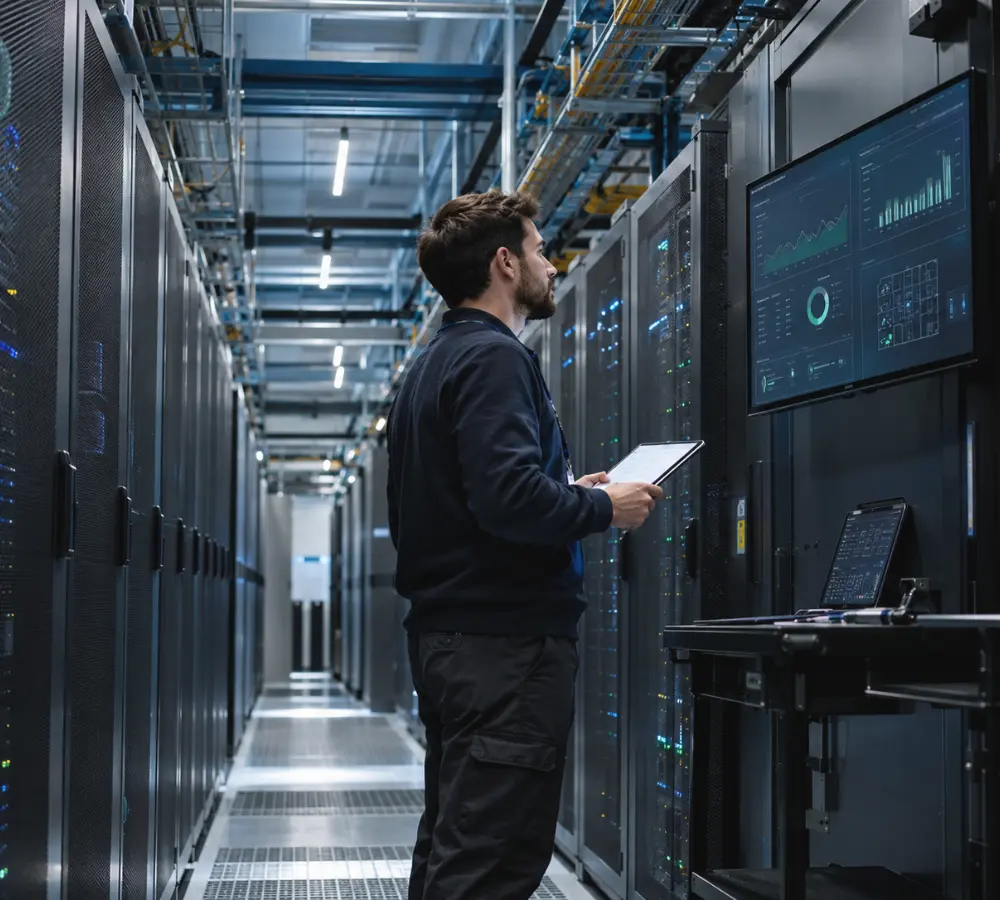
Foqum has developed an energy simulation and optimization tool based on a digital twin of the data center, enabling the modeling of various configurations and the hourly analysis of their performance.
Based on variables such as location, room and rack configurations, cooling systems, and energy procurement models, the tool reproduces the expected behavior of the data center, enabling scenario simulation and comparison to identify more efficient configurations from an energy, economic, and environmental perspective.
The engine calculates IT power consumption, subsequently aggregates the demand of each room, and incorporates the impact of cooling systems, electrical losses, and other infrastructure-related consumption. Based on this, the solution provides an integrated view of key metrics such as PUE (Power Usage Effectiveness)—which measures the ratio of total energy consumed by the data center to the energy delivered directly to IT equipment—peak power demand, energy losses, electricity costs, and CO₂ emissions.
The simulation is performed at hourly resolution—up to 8,760 hours for a full year—allowing users to observe how energy behavior evolves under different conditions and configurations. Additionally, the results can be exposed via API for seamless integration into dashboards and other enterprise tools.
In this way, the combination of modeling, simulation, and digital twin technology transforms the tool into a decision-support environment to explore alternatives and identify energy optimization opportunities in data centers prior to moving into subsequent design and engineering phases.